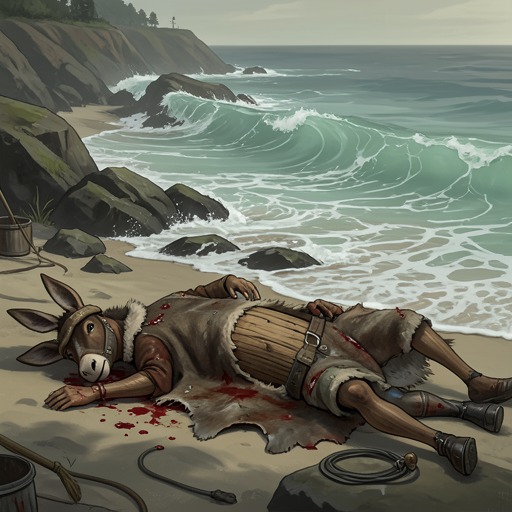
Pinocchio is injured at the circus and sold to make a drumhead
The Adventures of PinocchioPinocchio is injured at the circus and sold to make a drumhead marks the brutal end of his career as a performing donkey: a boy who once appeared on a puppet stage is trained, displayed, and finally priced for his skin. The episode makes performance a form of bodily control, while the brief sight of the Fairy in the audience turns the show into an unexpected moment of recognition before an accident closes that possibility.
From Toyland to the Circus
The episode follows Pinocchio’s transformation in the Land of Toys and the Little Man’s sale of him. When the Little Man comes to the room where Pinocchio and Lamp-Wick have been shut in, he recognizes their braying, then grooms them, curries their coats until they shine, bridles them, and takes them to a distant marketplace. Lamp-Wick is bought by a farmer whose donkey has just died; Pinocchio goes to a circus owner who intends to teach him tricks for audiences. Their different buyers separate the two companions, while Pinocchio’s polished appearance prepares him to be displayed as a marketable performer.
The narrator explains the Little Man’s business beyond this individual sale: he seeks out boys who are lazy, dislike books, want to leave home, or are tired of school, takes them to the Land of Toys, and lets them play until they become donkeys. He then sells them at market; the narrator says this trade has made him a millionaire. Pinocchio’s circus contract is therefore one link in a larger system that turns children’s rejection of school and work into an opportunity for exploitation. His own misfortune is framed as a warning to disobedient boys, but the scene also shows the material cost of the Little Man’s enterprise falling on its victims.
Training and Public Performance
The circus owner makes clear that Pinocchio is not being kept simply to receive food and drink: he is expected to earn money. His training is imposed whether he likes it or not. He must learn to jump and bow, dance a waltz and a polka, and stand on his head. The process takes three months and many lashings before the owner considers him ready. His new skills are thus acquired through coercion, and his body becomes the instrument by which someone else expects to profit.
The owner advertises the result as a spectacle, announcing leaps and exercises by the company’s artists and horses and the first public appearance of the famous donkey called Pinocchio. During the performance, the master directs him through commands: Pinocchio changes his step, gallops, and runs at full speed. A pistol shot accompanies the run, and Pinocchio falls as if dead. The audience applauds when he rises. What spectators receive as an accomplished act depends on his obedience to cues and on the illusion of death; the performance makes control over his body visible, even as the applause rewards the spectacle rather than the effort and punishment behind it.
Recognition and Injury
Among the spectators, Pinocchio sees a beautiful woman wearing a gold chain and a medallion with the picture of a Marionette. He recognizes the image as himself and the woman as the Fairy. The discovery floods him with happiness, and he tries to call out to her. His recognition is private: the crowd sees a trained donkey, while he sees someone dear to him in the audience. The moment briefly reconnects his present animal form with his former identity, but the show continues around him; the manager calls for another trick, and no one knows that Pinocchio is weeping.
For the next exercise, Pinocchio repeatedly goes under a ring instead of jumping through it. On the fourth attempt, at a look from his master, he leaps; his hind legs catch in the ring, and he crashes to the floor. He gets up lame and can barely limp back to the stable. The accident is not a planned part of the act: the ring that he is ordered to clear becomes the immediate cause of his lasting injury. The boys in the orchestra call for him, saddened by what happened, but Pinocchio is not seen again that evening. The next morning, a veterinarian declares that he will be lame for the rest of his life.
Sale for the Hide
The manager treats the prognosis as a commercial calculation. Asking what use he has for a lame donkey, he sends Pinocchio to the market. A buyer appears and asks the price; the manager asks four dollars, but the buyer offers four cents because he wants the animal’s hide, not his labor. He explains that he intends to make a drumhead from the tough skin for a drum needed by his village musical band. The gap between the asking price and the offer registers Pinocchio’s sudden reduction in value: once unable to perform, he is worth only what can be taken from his body.
After paying, the buyer takes Pinocchio to a high cliff above the sea. He ties a stone around Pinocchio’s neck, fastens a rope to one hind foot, pushes him over, and waits for him to drown so that he can skin him and make the drumhead. The episode ends with Pinocchio sinking and the buyer waiting on the cliff. The intended transformation from living performer to musical instrument carries the circus’s logic to its extremity: first Pinocchio’s body is trained to entertain an audience, then, when injured, it is treated as raw material for another performance.